Projects
Black Sea Mining Riser Concept Design
2H’s oil and gas riser expertise helped a client develop an innovative seabed mining riser design for a first-of-its-kind project in the Black Sea.
Sectors & systems
Oil & Gas Drilling, Completion & Workover RisersCapabilities & services
Concept EngineeringKey Personnel
Anthony Falsetta
Principal Engineer, UK

About
Anthony is an Incorporated Marine Engineer and Project Manager with over 18 years’ experience in the offshore renewables and oil & gas sectors. Specialising in fixed platforms, jacket pre-piling and monopile installation structures, minimum facility platforms and hardware design and supply, he has expertise in all phases of offshore projects from concept development through to delivery, operation, and inspection and maintenance, and has delivered a variety of offshore projects globally, including many ‘industry first’ solutions.
Anthony is also an active member of the Institute of Marine Engineering, Science & Technology’s Offshore Renewables Specialist Interest Group where he works to advance the renewables sector by mentoring emerging talent and shaping industry guidelines to support sustainable growth and technological progress.
Language
Background
A newly formed subsea mining exploration company in Eastern Europe wanted to extract sediment and minerals from the seabed of the Black Sea. However, they were unfamiliar with the technical issues associated with deepwater and the technologies available to achieve this.
The company turned to 2H because of our reputation, track record and independence in offshore deepwater riser design to help conceptualise a system. The project scope included identifying companies that have the relevant knowledge, experience and skills to conduct feasibility and concept studies of the seabed mining equipment, vertical transport riser system and surface process/storage facilities.
Exploratory Research
To understand what the riser system had to be designed to do, we first engaged with a specialised hydraulic research organisation to simulate the slurries and analyse their flow properties. Samples of the materials found at the bottom of the Black Sea showed a soft surface layer and a hard embedded layer underneath, which needs to be extracted in two phases.

Riser Configuration
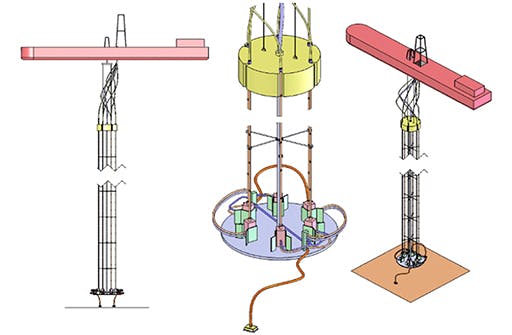
We designed a riser system with a grouped riser array comprising multiple steel pipe strings so that the riser strings can be installed and retrieved individually from the host vessel’s deck without disrupting production. The slurry is forced up each pipe by pumps located at its bottom end or distributed along the riser length.
The design offers redundancy to eliminate the need to recover the entire riser system for maintenance, minimising downtime, and also allows for different pump types to be used depending on the client’s preference and budget.
Equipment & Vendor Assessment
We identified suppliers of mining pumps that could handle the abrasive slurries, large volumetric flow rates and high-pressure head, and invited them to propose designs that could meet the project’s needs. This was followed by a pump evaluation, which was presented to the client.
Three seabed crawler designers were invited to participate in a concept design competition and the concept most suited to working in the Black Sea’s difficult seabed geography was selected by a panel of experts.
We also engaged with third party experts throughout the project to address specific issues, such as deck handling facilities, and environmental and metallurgical issues, amongst others.
Challenges
The high, commercially driven production rates required multiple large diameter pipes to create the flow volume needed to make the project profitable. This resulted in a formidable overall system weight. We were able to reduce the payload on the vessel by incorporating a near-surface buoyancy tank suspended below the vessel to support the majority of the riser’s weight.
We also had to address the hydrogen sulphide (H2S) levels in the water below 150m. This presented a unique challenge in material selection for the subsea components, as it can cause material embrittlement and structural failure very quickly. The highly anaerobic water coming up in the slurry also has to be disposed of back to the deep so that it does not affect the marine life in the upper water layer. We included return pipes in the riser bundle to accomplish this.
This project was very different to our usual oil and gas riser work in terms of design function, riser configuration, and seawater environment, but with our extensive deepwater experience and innovative approach, we were able to adapt our expertise to seabed mining.
Results
This project was very different to our usual oil and gas riser work in terms of design function, riser configuration, and seawater environment, but with our extensive deepwater experience and innovative approach, we were able to adapt our expertise to seabed mining.
We completed the project in just under two years from kick-off, through concept design and cost estimation, to final presentation. The design and cost estimate allowed the client to approach potential investors, including the governments of the seven countries surrounding the Black Sea, to participate in this unprecedented and ambitious project. This phase of the project is on-going.
Sectors & systems
Oil & Gas Drilling, Completion & Workover RisersCapabilities & services
Concept EngineeringKey Personnel
Anthony Falsetta
Principal Engineer, UK

About
Anthony is an Incorporated Marine Engineer and Project Manager with over 18 years’ experience in the offshore renewables and oil & gas sectors. Specialising in fixed platforms, jacket pre-piling and monopile installation structures, minimum facility platforms and hardware design and supply, he has expertise in all phases of offshore projects from concept development through to delivery, operation, and inspection and maintenance, and has delivered a variety of offshore projects globally, including many ‘industry first’ solutions.
Anthony is also an active member of the Institute of Marine Engineering, Science & Technology’s Offshore Renewables Specialist Interest Group where he works to advance the renewables sector by mentoring emerging talent and shaping industry guidelines to support sustainable growth and technological progress.