

Why Floating Offshore Wind Needs to Take Mooring Line Out-of-Plane Bending Fatigue Seriously
As the floating offshore wind industry transitions from pilot projects to commercial-scale developments, confidence in mooring system reliability is becoming a critical success factor. While developers have focused significant attention on turbine technology, foundations and energy yield, there is a growing recognition that the long-term integrity of the mooring systems can have an equally important impact on project performance and operational expenditure.
21 Sep 2026
Authors

Owen Pocock
Technical Manager, UK

About
Owen is a Principal (chartered) Engineer with over ten years’ specialist experience in advanced numerical analysis and structural engineering of offshore wind farms, drilling and production riser systems. Owen’s oil and gas project portfolio covers a range of riser types and systems (rigid and flexible) in deep and shallow water around the globe. He has also performed numerous engineering assessments and package management roles for both fixed-bottom and floating wind farm developments. Owen is experienced in concept, pre-FEED, FEED and Detailed Design for EPCI projects.
Expertise


Philippe Jean
Technical Authority Hydrodynamics, France

About
Philippe Jean is based in 2H’s Paris office and has 25 years of experience in concept engineering for floating production systems. He is responsible for expanding 2H’s technical expertise in floating system design for oil & gas, floating wind, OTEC, wave energy and mooring systems and developing innovative technology solutions to drive future growth in the offshore energy sector. In addition, he is a key technical advisor providing support to 2H’s projects globally.
Phillipe possesses an MSc in ocean and subsea engineering and has an impressive track record in technology development that includes the first deep water polyester moorings, steel deep water offloading export systems, a largescale FLNG turret and wave energy converter. More recently, Phillipe was responsible for the design, build and operation of an innovative data collection buoy, which monitors real-time wind, waves, birds and marine mammals in preparation for the AO6 floating wind farm, offshore France. Philippe has previously worked with Ocergy, SBM Offshore and the French Navy.
For many projects, fatigue assessments continue to focus primarily on tension-tension (TT) loading. However, emerging evidence suggests that TT fatigue alone does not always capture the full stress environment experienced by mooring chains and connectors. To achieve a more realistic understanding of asset life, engineers must also consider out-of-plane bending (OPB) and in-plane bending (IPB) fatigue effects. These mechanisms can significantly influence fatigue damage within critical mooring components and should be evaluated as part of a comprehensive design and life- assessment strategy.
The evolving challenge of floating wind mooring design
Unlike fixed-bottom wind turbines, floating wind assets rely entirely on mooring systems to maintain station and ensure safe turbine operation. These systems are continuously exposed to combined wind, wave and current loading, while also responding to turbine-induced motions in six degrees of freedom.
Over a typical project life of 25 years or more, mooring chains experience millions of loading cycles. Understanding how this loading translates into fatigue damage is fundamental to ensuring long-term asset reliability and reducing uncertainty in life predictions.
Yet many conventional fatigue assessments still focus solely on cyclic tension loading within the mooring line. While this remains a vital design consideration, it represents only part of the fatigue picture.
Why conventional fatigue analysis can miss critical damage mechanisms
In real-world mooring systems, chain links do not always rotate freely. Restrictions can occur at chain stoppers, fairleads, large clump weights, subsea connectors, shackles and other locations where the geometry of the connection limits natural movement.
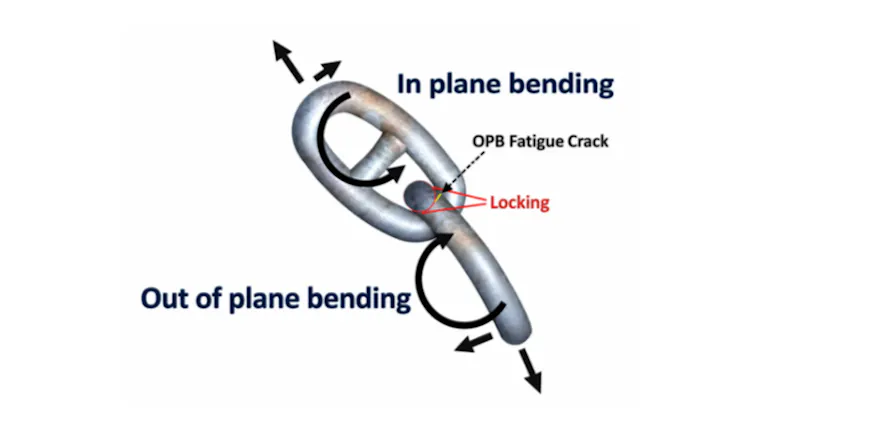
Mooring Line Chain Link Locking
When this happens, bending stresses can develop within the chain links themselves. The result is
the generation of:
• Axial tension forces
• Out-of-plane bending (OPB) moments
• In-plane bending (IPB) moments
These loads do not act independently. Instead, they occur simultaneously and interact with one another, creating a much more complex fatigue response than that captured by traditional TT analysis alone. The highest fatigue damage is often concentrated in links located closest to the point of rotational restriction.
For floating offshore wind applications, the challenge is amplified by the dynamic motion characteristics of floating structures. Platform surge, sway, heave, pitch, roll and yaw motions continually alter mooring line geometry, increasing the importance of understanding how relative chain-link rotations contribute to fatigue damage.
Ignoring OPB effects can therefore lead to an under-conservative assessment of component life and may underestimate fatigue accumulation in key mooring system interfaces.
The industry challenge of computationally intensive analysis
Despite its importance, the OPB fatigue assessment has traditionally been viewed as a specialist and computationally demanding exercise. Conventional industry approaches often require the creation of multiple detailed finite element models of chain links to establish relationships between relative link rotation and the associated bending moments. These analyses can be highly resource-intensive, particularly when applied across the numerous environmental conditions and operating scenarios required for floating wind projects. The challenge for developers is clear: how can engineers robustly quantify OPB fatigue without introducing excessive modelling complexity, long project schedules or significant computational costs?
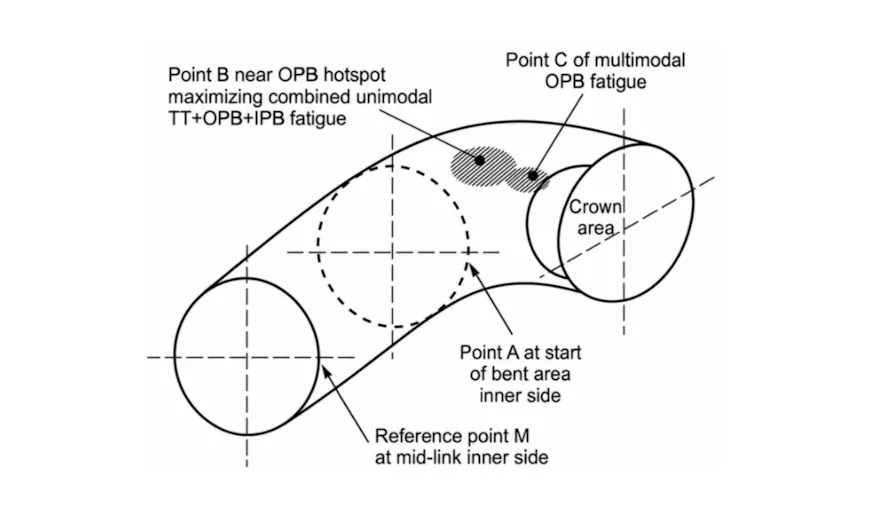
Mooring Line Chain Link Fatigue Hotspots
2H’s simplified OPB fatigue approach
Recognising the industry's need for a more practical solution, 2H developed an innovative methodology for assessing combined TT, OPB and IPB fatigue damage using a significantly simplified workflow. The approach was established through internal research and development activities aimed at overcoming the limitations of conventional OPB assessment techniques. Rather than relying on large numbers of detailed finite element chain-link models, the methodology derives the critical relationship between relative link angle and bending moment directly from global dynamic mooring analyses.
This approach enables key OPB and IPB fatigue mechanisms to be captured while substantially reducing modelling effort and computational demands. The methodology provides a practical framework for:
Determining OPB and IPB moment behaviour from dynamic mooring simulations
Accounting for the interaction between tension loading and bending effects
Evaluating combined fatigue damage mechanisms
Identifying critical fatigue hotspots within mooring systems
Supporting more robust life assessments for floating offshore wind assets
By simplifying what has historically been a complex engineering challenge, our approach allows OPB considerations to be incorporated efficiently into project design studies, life extension assessments and integrity management programmes.
Delivering a more realistic understanding of mooring fatigue
A key benefit of the methodology is that it acknowledges the reality that fatigue damage within mooring systems is rarely driven by axial tension alone. Through an integrated assessment of TT, OPB and IPB loading effects, engineers gain a much more representative understanding of the stresses experienced by critical mooring components throughout their operational life.
Looking ahead
As floating offshore wind moves towards commercialisation, the industry must ensure that mooring integrity assessments keep pace with increasing technical demands. Out-of-plane bending fatigue is no longer a niche consideration. It is a critical element of understanding true mooring system performance and ensuring long-term asset reliability. By developing a simplified and more efficient methodology for evaluating combined TT, OPB and IPB fatigue damage, 2H has helped make advanced OPB assessments more accessible to the floating offshore wind sector. The result is a more realistic understanding of mooring system behaviour, enabling developers and operators to make better-informed decisions about design, integrity management and asset life.
For an industry built on delivering reliable renewable energy for decades to come, understanding and accurately quantifying OPB fatigue is not simply good engineering practice. It is an essential part of securing the long-term success of floating offshore wind.
Authors
Owen Pocock
Technical Manager, UK
About
Owen is a Principal (chartered) Engineer with over ten years’ specialist experience in advanced numerical analysis and structural engineering of offshore wind farms, drilling and production riser systems. Owen’s oil and gas project portfolio covers a range of riser types and systems (rigid and flexible) in deep and shallow water around the globe. He has also performed numerous engineering assessments and package management roles for both fixed-bottom and floating wind farm developments. Owen is experienced in concept, pre-FEED, FEED and Detailed Design for EPCI projects.
Expertise
Philippe Jean
Technical Authority Hydrodynamics, France
About
Philippe Jean is based in 2H’s Paris office and has 25 years of experience in concept engineering for floating production systems. He is responsible for expanding 2H’s technical expertise in floating system design for oil & gas, floating wind, OTEC, wave energy and mooring systems and developing innovative technology solutions to drive future growth in the offshore energy sector. In addition, he is a key technical advisor providing support to 2H’s projects globally.
Phillipe possesses an MSc in ocean and subsea engineering and has an impressive track record in technology development that includes the first deep water polyester moorings, steel deep water offloading export systems, a largescale FLNG turret and wave energy converter. More recently, Phillipe was responsible for the design, build and operation of an innovative data collection buoy, which monitors real-time wind, waves, birds and marine mammals in preparation for the AO6 floating wind farm, offshore France. Philippe has previously worked with Ocergy, SBM Offshore and the French Navy.